

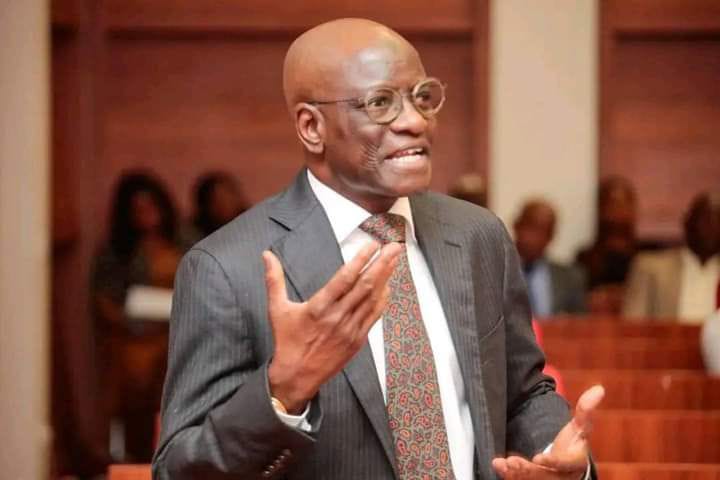
An accounting scholar and former oil industry executive, Dr. Kingsley Ade Adegbite, has dismissed Senator Ahmed Wadada’s allegation of a ₦210 trillion discrepancy in the accounts of the Nigerian National Petroleum Company Limited (NNPCL), describing the claim as economically implausible and rooted in a misunderstanding of the company’s financial structure.
Adegbite, a former Business Development Manager for Sub-Saharan Africa at BP, said in an opinion published on Friday that the figure being cited in the allegation collapses under “simple arithmetic and basic financial scrutiny.”
According to him, the amount being referenced is far beyond the scale of Nigeria’s fiscal capacity during the period under review.
He noted that between 2017 and 2020, Nigeria’s entire federal budget ranged between about ₦7 trillion and ₦10 trillion annually, only rising significantly in more recent years.
“Even in recent budgets, national spending has struggled to cross ₦20 trillion. To suggest that a single government company misplaced ₦210 trillion implies sums several times larger than Nigeria’s annual national budget for multiple years combined,” Adegbite said.
He argued that for such a claim to be credible, NNPCL would have had to generate and lose funds exceeding the fiscal capacity of the Nigerian state itself.
The scholar also faulted what he described as a misinterpretation of the structure of the national oil company, particularly regarding the operations of NNPC Upstream Investment Management Services Limited (NUIMS), formerly the National Petroleum Investment Management Services (NAPIMS).
Adegbite explained that NUIMS operates as an internal investment management arm responsible for administering Nigeria’s upstream joint venture interests and functions within multiple layers of corporate and regulatory oversight.
These, he said, include NNPC corporate approvals, joint venture partner governance, budget authorisations, work programme approvals and regulatory supervision.
“There is simply no operational pathway through which NUIMS could independently disburse tens or hundreds of trillions of naira outside corporate control and partner scrutiny,” he said.
He also cautioned against what he described as the sensational interpretation of joint venture accounting entries, noting that oil and gas financing typically involves long financial cycles.
According to him, joint venture accounting often includes multi-year project financing, legacy liabilities, capital programme carryovers and reconciliation of earlier commitments, which can span several fiscal years.
“Taking cumulative accounting adjustments and presenting them as mysterious new expenditures is not forensic discovery. It is a misinterpretation of complex financial records,” he said.
Adegbite also addressed the controversy surrounding the reported ₦5 billion spent during the transition from NNPC to NNPCL.
He said the transition was not merely a cosmetic name change but part of the structural reforms required under the Petroleum Industry Act (PIA), which transformed the national oil corporation into a commercially oriented limited liability company.
The process, he explained, involved corporate restructuring, legal incorporation, governance redesign, asset and liability transfers, and compliance with international corporate standards.
He added that the rebranding also covered a global rollout that included a new corporate identity, logo redesign, billboards across major cities, advertising campaigns, signage changes and digital platform transitions.
“For a national oil company with global partnerships, such rebranding exercises are standard practice and extend far beyond printing new letterheads,” he said.
Adegbite further expressed concern that sensational allegations about the oil sector often dominate headlines before undergoing technical scrutiny.
He warned that exaggerated figures could distort public perception, erode institutional credibility and undermine investor confidence in Nigeria’s oil industry.
The expert stressed that legislative oversight of public institutions remains essential but must be guided by technical understanding and evidence-based analysis.
He concluded that the ₦210 trillion discrepancy claim does not align with Nigeria’s fiscal realities, the governance framework of the national oil company or the financial mechanics of joint venture operations.
“What initially appears as a monumental financial scandal quickly dissolves into a phantom figure that exists more comfortably in political rhetoric than in verifiable financial records,” he said.