

By Olalekan Saheed Badmus (Phoenix)
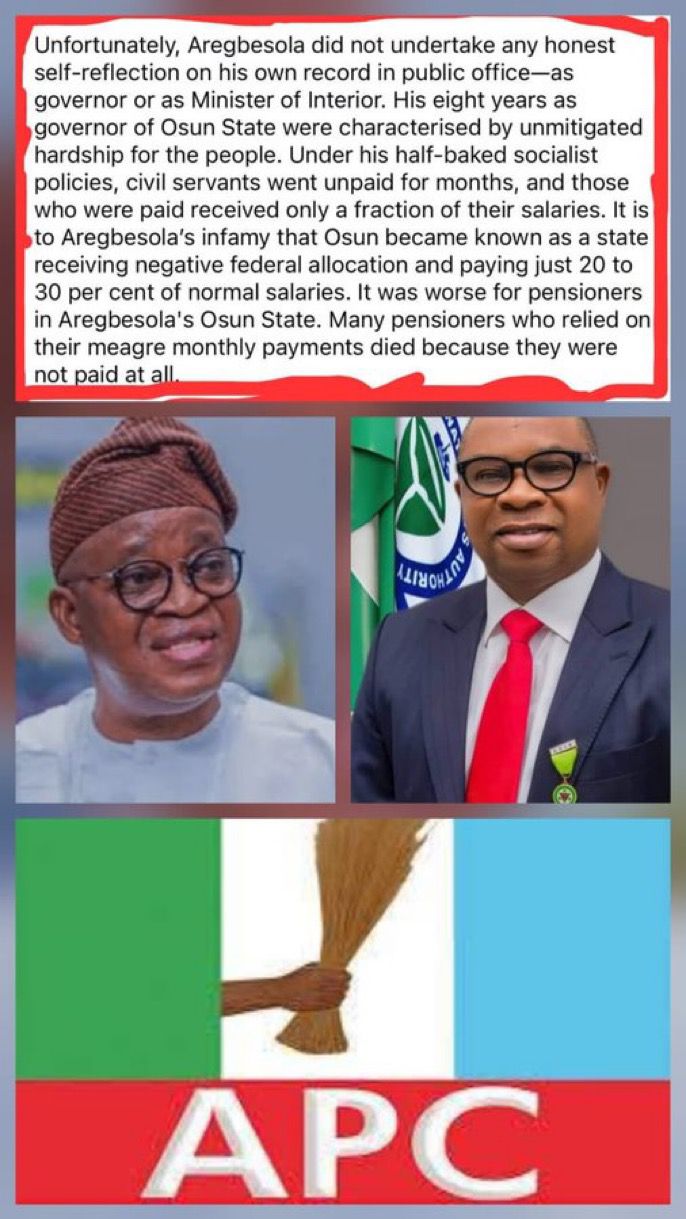
When Bayo Onanuga, spokesperson to President Bola Ahmed Tinubu issued his scathing critique of Rauf Aregbesola, a former Governor of Osun State and former Minister of Interior, he may not have intended it as a political confession. Yet, embedded within his words is a striking admission, one that inadvertently validates what the people of Osun State have long endured and consistently expressed at the ballot box: the All Progressives Congress (APC) presided over years of hardship, economic distress, and administrative failure in Osun State.
Onanuga’s statement lays bare a clear reality. By acknowledging unpaid salaries, fractional wage payments (Hafusa), pension neglect, and fiscal recklessness under Aregbesola’s administration, he effectively confirms that Osun State was pushed to the brink under the APC leadership. But that alone does not tell the whole story; Aregbesola did not govern in isolation. Governance is collective, and the failures of that era must be attributed not to just one man, but to the entire APC structure that enabled, executed, and sustained those inhumane policies.
For twelve years, Osun people groaned under policies that exposed administrative shortcomings and set the state and the people back. Civil servants were reduced to economic uncertainty, pensioners left to despair, and the state’s financial credibility pushed to a subject of national ridicule. Yet, standing actively beside Aregbesola throughout this period was his Chief of Staff, current Minister of Marine and Blue economy, Alh. Gboyega Oyetola, a central figure in the administration’s decision making machinery. To suggest that Oyetola bears no responsibility for the outcomes of that administration is to ignore the very essence of governance.
More telling is what followed. Oyetola did not merely observe the aftermath of that administration, he inherited power after it. His four-year tenure presented a critical opportunity to correct the excesses and rebuild trust. However, by Onanuga’s own indirect admission, much of the “mess” persisted. If indeed he “worked hard,” the results did not sufficiently translate into relief for Osun people, nor did they erase the deep scars left by years of maladministration. His tenure largely focused on continuity, not correction. Inherited salary and pension arrears were left unpaid, no significant reduction in the state debt profile, workers promotion was stalled for years among others.
Equally significant is the role of the APC’s current political actors in Osun. The Osun APC gubernatorial candidate for the August 2026 election, Bola Oyebamiji, served as Commissioner for Finance during the later years of the Aregbesola administration and also the entire tenure of Alhaji Oyetola. Fiscal policy, debt accumulation, and salary structures fell squarely within his purview. If Osun’s finances were mismanaged, then accountability must extend to those who managed the books. The same applies to other key figures who held strategic positions during that period, including the current APC National Secretary, Ajibola Basiru and prominent party operatives like Oluomo Sunday Akere, Remi Omowaiye, Timothy Owoeye among others. They were not bystanders; they were active participants in the misgovernance of Osun by the APC.
This is why the attempt to isolate Aregbesola as the sole architect of Osun’s past struggles is both misleading and politically convenient. Onanuga’s critique, while targeted, inadvertently dismantles that narrative. If Aregbesola’s tenure was indeed as damaging as described, and evidently so, then it was a collective failure of the Osun APC. This failure spanned cabinet members, financial managers, political strategists, and successors who carried the same governance DNA forward.
In sharp contrast stands the current administration of Senator Ademola Adeleke. Since assuming office in November 2022, Adeleke has focused on systematically addressing the burdens inherited from his predecessors. The clearing of half salary arrears, payment of pension and gratuity backlogs, settlement of promotion arrears, and deliberate efforts to reduce the state’s debt profile represent clear policy actions, and a restoration of dignity to Osun workers, retirees and by extension the people of the state. These are measurable interventions that directly touch lives, as an antidote to several years of uncertainty.
Beyond financial remediation, Adeleke’s governance has reintroduced a sense of stability and trust in public administration. Where there was opacity in governance, there is now greater transparency; where there was hardship, there is now gradual relief. This contrast is precisely why the people of Osun have, through democratic expression, distanced themselves from the APC and its legacy.
It is therefore not enough for the Osun APC to repackage itself or recycle familiar faces. The party must confront its past with an honesty assessment. Before seeking another mandate, it owes the people of Osun a sincere apology, one that acknowledges the pain of the past; the unpaid wages, the suffering of pensioners, and the economic dislocation experienced under its watch. Anything short of this amounts to political amnesia.
Ultimately, Onanuga’s words have done what many voices have long argued, they have validated the lived experiences of Osun citizens. This verdict is no longer about politics, it is now internal. And if that verdict is to mean anything, it must lead to sincere reflection, accountability and above all, justice in the court of public opinion.
Osun remembers. And in remembering, it has chosen a clear and different path with Governor Ademola Adeleke. A path that rejects the burdens of the past and embraces a future built on responsibility, responsiveness, and tangible results. We will never go back to the years of ruins but we will always remember them and those who took us there!
Olalekan Saheed Badmus (Phoenix) writes from Osogbo and can be reached on basletp2@gmail.com