

By George Okechukwu
ABUJA — For weeks, the figure had hung over Nigeria’s oil industry like a dark cloud. Across television studios, newspaper headlines, social media platforms and political circles, one question echoed relentlessly: Had ₦210 trillion disappeared from the books of the Nigerian National Petroleum Company Limited (NNPC Ltd.)?
The allegation had stirred outrage, fuelled endless debates and cast fresh scrutiny on the nation’s most strategic company. Nigerians waited with bated breath as the Senate Committee on Public Accounts prepared to hear from one man many believed possessed intimate knowledge of the issues at stake—former Group General Manager of the National Petroleum Investment Management Services (NAPIMS), Alhaji Bala Wunti.
By the time the committee reconvened in Abuja, expectations had reached fever pitch. Many anticipated dramatic revelations, heated exchanges or perhaps confirmation of what would rank among the biggest financial scandals in the country’s history.
Instead, what unfolded was a masterclass in industry knowledge, institutional memory and calm persuasion.
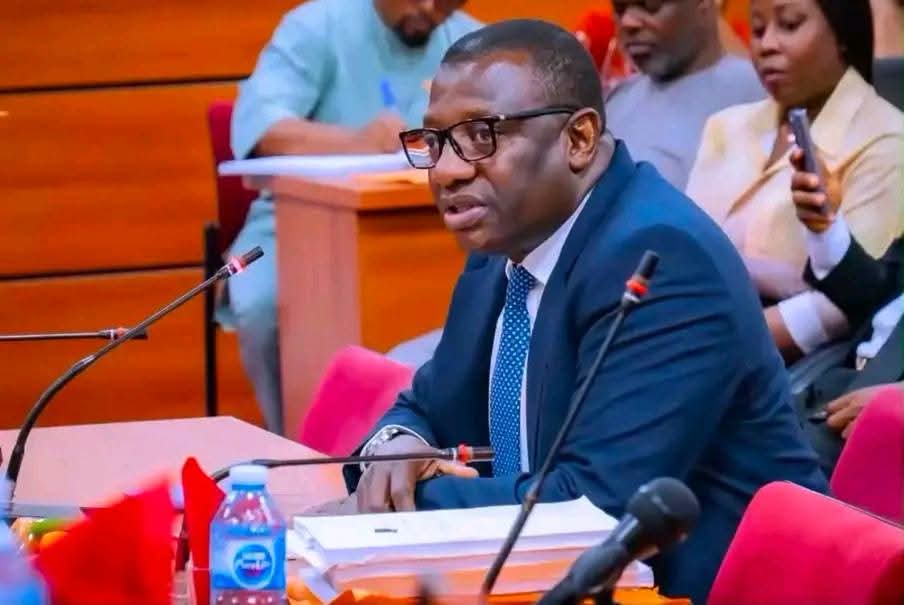
Walking into the hearing room with little fanfare, Wunti appeared unhurried and composed. There was no attempt to dramatise the proceedings or inflame emotions. Armed with a detailed report the committee had requested him to prepare, he began methodically dismantling what had become one of the most controversial narratives surrounding NNPC Ltd.’s 2023 audited financial statements.
As he spoke, it quickly became apparent that he was relying not merely on the written report before him but on decades of experience inside Nigeria’s petroleum industry. Having led NAPIMS through the transition triggered by the Petroleum Industry Act (PIA) and later served as Chief Upstream Investment Officer of NNPC Upstream Investment Management Services (NUIMS), Wunti demonstrated an intimate understanding of the intricate workings of Nigeria’s national oil company.
Ironically, midway through his presentation, he paused to make a humble admission.
“I’m not an accountant,” he told the committee.
Yet what followed only reinforced the depth of his mastery. With remarkable dexterity, he simplified technical accounting concepts that had generated weeks of public confusion, explaining the unique financial architecture of NNPC Ltd. in language that both lawmakers and ordinary Nigerians could understand. By the end of his presentation, many senators who had arrived seeking answers appeared reassured that the sensational claims of missing trillions had little basis in the audited accounts before them.
“I have gone through page to page of this document,” Wunti declared. “I have not found where ₦210 trillion was mentioned.”
That statement marked the turning point of the hearing.
According to Wunti, the controversial figure did not exist as missing money anywhere in the audited financial statements. Rather, it resulted from adding together two completely different balance sheet entries—about ₦107 trillion recorded as sundry receivables and approximately ₦103 trillion listed as accrued expenses.
He broke the issue down in simple terms.
Receivables, he explained, represent money owed to NNPC Ltd. by other parties, while accrued expenses are obligations the company itself owes to suppliers, contractors and other entities. International accounting standards require both figures to be disclosed separately because they represent entirely different financial positions.
“They cannot simply be added together and declared missing money,” he explained.
Speaking under oath, Wunti maintained that nothing in the audited financial statements supported the allegation that ₦210 trillion had disappeared.
“By all my understanding of accounting, this cannot represent money missing. I am of the opinion that there is no ₦210 trillion missing based on the audited financial statements that I reviewed.”
The hearing increasingly resembled a graduate lecture in hydrocarbon accounting rather than a political interrogation.
Seeking to help lawmakers understand the broader context, Wunti explained that NNPC Ltd. is fundamentally different from an ordinary commercial company. While private firms exist primarily to maximise profits, national oil companies are required to perform several statutory responsibilities simultaneously.
According to him, NNPC Ltd. functions as a commercial enterprise, manages petroleum assets on behalf of the Federation and also safeguards Nigeria’s energy security.
To illustrate how things operated before the Petroleum Industry Act came into force, Wunti drew laughter when he described the old NNPC structure as “Jollof Rice”—a mixture of commercial, regulatory and policy responsibilities bundled into one institution.
The PIA, he explained, was enacted largely to separate those responsibilities and improve governance.
That separation also necessitated separate accounting books—one for commercial operations and another for managing Federation assets—making the company’s financial statements significantly more complex than those of conventional corporations.
“The complexity makes it expedient to keep more than one book of accounts,” he explained.
Wunti also addressed another controversy that had attracted widespread public attention—the claim that ₦5.8 billion was spent merely to incorporate NNPC Ltd. following the enactment of the PIA.
He clarified that the actual statutory payments made to the Corporate Affairs Commission (CAC) and the Federal Inland Revenue Service (FIRS) for filing fees and stamp duties amounted to about ₦2.45 billion.
The larger figure, he explained, resulted from accounting entries recorded separately in different books maintained for different statutory purposes during the incorporation process.
“The only money paid was about ₦2.5 billion and it went directly to government institutions. No third party received any payment,” he said.
Looking beyond the controversy, Wunti recommended closer collaboration between NNPC Ltd., the Office of the Accountant-General of the Federation and the Office of the Auditor-General to promote a shared understanding of the company’s unique accounting framework.
He also urged a broader appreciation of the Constitution, the Petroleum Industry Act and other relevant laws governing the operations of Nigeria’s national oil company.
At the conclusion of the presentation, Committee Chairman, Senator Ibrahim Dankwambo, said members would thoroughly study Wunti’s written submission before determining whether further clarification would be required.
He also addressed the public narrative surrounding the hearing.
“For information of the public, they kept saying missing. We never said it is missing. We said the figures were unexplained and required clarification,” Dankwambo stated.
The committee subsequently resolved to review both the written report and the audited financial statements before deciding on the next course of action.
As senators rose from the hearing, the atmosphere was markedly different from the tension that had preceded it. The expectation of exposing a monumental financial scandal had given way to a clearer appreciation of the complexities of petroleum accounting and the danger of drawing sweeping conclusions from misunderstood financial entries.
Whether the debate finally ends will depend on the committee’s eventual report. But for those present inside the Senate hearing room, one thing was unmistakable: with composure, uncommon clarity and an encyclopaedic understanding of the petroleum industry, Bala Wunti succeeded in dismantling what had become Nigeria’s most talked-about accounting controversy, replacing suspicion with explanation and restoring confidence that the much-publicised “phantom ₦210 trillion” was, indeed, just that—a phantom.
The author is a Lagos based oil and gas executive